

By Todd Paetznick, January 13, 2026
Decision-making can feel overwhelming at times and result in nothing getting done. At times, we can feel paralyzed by indecision and fear of doing the wrong thing, and the complexity of options. There may be so many decisions to make that it is unclear what the best next step is.
Prioritizing is key. What is most urgent and what is unimportant?
The President of the United States makes some of the most complex decisions. These decisions are consequential and affect millions (maybe billions) of people. Before he became president, Dwight D. Eisenhower was a military man who served as the General in charge of the Allied forces during World War II. The decisions he needed to make during the war were crucial. They often meant the difference between life and death for the people serving under his leadership. For efficiency, Eisenhower used a simple decision-making technique to prioritize tasks. This technique is now known as the Eisenhower Matrix. It is widely used by powerful people worldwide.
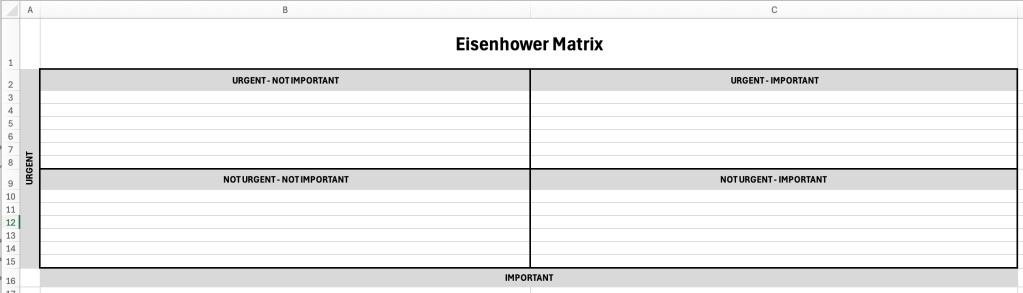
The Eisenhower Matrix is a quadrant-based system. It is a square divided into four smaller squares, or quadrants, by vertical and horizontal lines. The Top Right quadrant contains urgent and important tasks and decisions. The Top Left quadrant contains Urgent but Not Important tasks. The Bottom-Right quadrant contains Important but Not Urgent tasks. The Bottom Left quadrant shows tasks that are Neither Important Nor Urgent.
How to Use the Eisenhower Matrix
What is your objective? Even before using the matrix to determine what needs to be done next, answer the “why” question. Consider why we are doing anything at all. What is our desired outcome from all of our efforts? Our decisions and tasks must move us closer to that outcome. Knowing where we want to go will ensure that every step we take moves us closer to that destination. And we will discover that clarity about that destination will simplify the categorization process and answer the “what” questions. As in, what do we need to do next?
The next step is to assign all decisions and tasks to the appropriate quadrant of the matrix. Categorizing decisions and tasks based on importance will help prioritize them. Assessing their urgency will narrow down what needs to be done next. Here is a summary of the matrix and its role in prioritization.
Urgent – Important. Tasks and decisions with deadlines and significant consequences. Do these first.
Urgent – Not Important. Delegate urgent tasks and decisions that do not require your involvement or expertise but must be done quickly. If the task/decision cannot be delegated, give these items your second priority.
Not Urgent – Important. Tasks and decisions without definitive deadlines can be deferred to a less hectic time. These will be your third priority.
Not Urgent – Not Important. Do not waste your time on these items. Prioritizing items into this category can sometimes reveal items that are not valuable at all. Delete these items from your matrix.
Revisit. Some tasks and decisions may not appear urgent or important, but their status changes over time. Similarly, some tasks and decisions may not have a deadline, but time reveals a different level of urgency. Adjust your
An Eisenhower Matrix as a Spreadsheet. If you are a spreadsheet person, build yourself something that looks similar to the one below. It will help you visualize your decisions and tasks, and you can cut and paste items as their priorities change. Create an area on your spreadsheet to save the progress you have made. Add a date to show when it was completed.
 toddpaetznick.com
Leave a comment